Photo: FJ Martinez
Published in The Wild Word Magazine LOVE Issue on February 18, 2024
Author

Photo: FJ Martinez
Published in The Wild Word Magazine LOVE Issue on February 18, 2024

Photo: SC Martinez
Published in Burningword Literary Magazine, Issue 109, January 2024. Nominated for Best of the Net 2024

Photo: SC Martinez / Photoshop: FM Martinez
Publishing in Arboreal Literary Magazine, Issue 4 Fresh Hell, December 2023
We were pretty wasted when Gus announced his birthday wish was for us, Arnold and I, to go deep-sea fishing with him. Gus loved the water, loved to fish, and wanted to show off his new boat. I’m not a big water guy. I got seasick watching Jaws, and I was pretty sure I wouldn’t enjoy a day on the water but refusing Gus and staying behind would’ve been worse. I’d been mostly vegetarian since leaving home from conviction, as well as economics. Since I’d been in New York, I’d forgotten the source of meat or fish was a living creature. Other than a fly or a mosquito, I’d never killed anything. I hoped today wouldn’t be the first.
We left the dock at 5:00 am. Three men in a boat. None had slept more than a few hours after drinking and talking about art and life well into the night, while a late summer storm raged outside that ended before dawn. A light mist, like a Turner seascape, burned off as we chugged east toward the sunrise through the inlet at East Marion, Long Island in Gus’s new twenty-five-foot Grady-White for its inaugural voyage on the Atlantic Ocean.
Nauseous immediately, I leaned over the boat’s side to empty my stomach into the inlet. With it went my Dramamine and any hope of enduring the journey unscathed. I should’ve taken the pill when Gus handed it to me the night before, but I’d fallen asleep with it in my tee-shirt pocket.
Gus was turning forty. He’d grown up poor in Yonkers proudly maintaining his horrible neighborhood accent. After high school, he joined the Navy before going to college on the G.I. Bill and earning a Ph.D. in Arts Education. He taught Painting and Printmaking at two local colleges. He was loud and tall with countless tattoos, big hands, and feet, and he seemed to take up most of the space in the boat.
“What’s the problem, Benny? We aren’t even out of the Sound. The water’s as smooth as a baby’s ass. How the fuck can you be sick already?” Gus rubbed my back. “You’ll get your sea legs soon.”
Gus and his wife, Jenny were both artists who lived in a Canal Street loft in Manhattan during the week. They’d invited Arnold and me with our significant others to their sprawling house with its own dock on the North Shore for Gus’s Labor Day weekend birthday celebration. The house was a wedding present from Jenny’s wealthy parents. She’d bought Gus a new boat for his milestone birthday after his smaller one sunk in a Nor’easter the previous spring.
“It’s going to be a great day, Benny. They say a bad day fishing’s better than a good day working. Look. Arnold isn’t sick.” Gus slapped his back causing Arnold to grab the gunwale.
Arnold, Gus’s former student, was also an artist. They’d become friends years ago, but I was a recent addition to his circle. Earlier in the year, my girlfriend, Celeste, and I met Gus through the Madison Avenue art gallery who represented him. The gallery owner hired us to collaborate with Gus to produce a limited-edition print to accompany his one-man show of Neon light paintings slated for the following year.
We both liked Gus from our first meeting and spent many hours together working on his print at our atelier. After a long day working in our loft, he’d take us out for Indian or Chinese food to talk about art until they closed the place for the night. We were eager listeners. He introduced us to his artist friends and gallery owners at openings, telling everyone they should hire us to make their prints.
(Click number 2 to continue reading the story.)
Photo: SC Martinez
Published in The Blue Mountain Review, September 2023
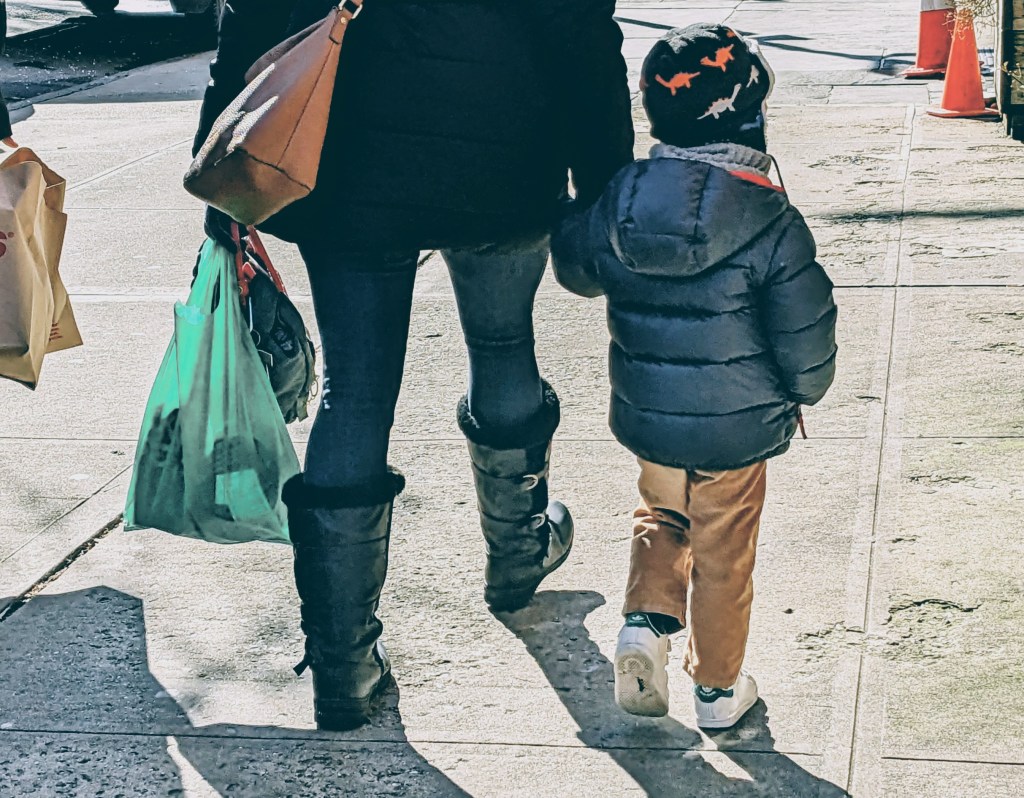
My thirty-year-old son sits across from me in the neighborhood diner. His hair is thinning at the front, but too long. He needs a haircut. At six months, he had a head of hair so thick it looked like an old man’s toupee.
I stumble into the emergency room, directed to a body strapped to a gurney, the face covered in blood, one leg splayed out at an unnatural angle. Who is this?
He smiles at a little joke he’s told me, and I see his straight even teeth, so different from his mouth as a two-year-old with milk teeth like a tiny comb.
A bloody hand reaches out to me with the tapered fingers and long thumb of a pianist. I shrink away from its coldness, but I know this hand.
He butters his toast and tells me about his week at work. His eyelashes are as long and dark as they were at birth, and they brush his cheeks when he smiles.
A neck brace keeps his mouth from moving. But I hear a faint voice say, I’m okay mom. I’m okay, don’t cry. It’s as if it’s come from a ghost.
I worry he works too much at his new job, striving to climb the rungs to the next level. As a toddler, he never sat down to eat. He always had an agenda, a project, a mission.
I need to cradle him. I need to count his fingers and toes and run my finger over his tiny ears, his nose, his mouth. But they take my baby away to the O.R.
I take his grownup hand in mine, squeeze it gently, and let go before he does. As a boy, he never wanted to hold my hand to cross the street, but I held it anyway.

Artwork: © SC Martinez
Published in The Blue Mountain Review, September 2023
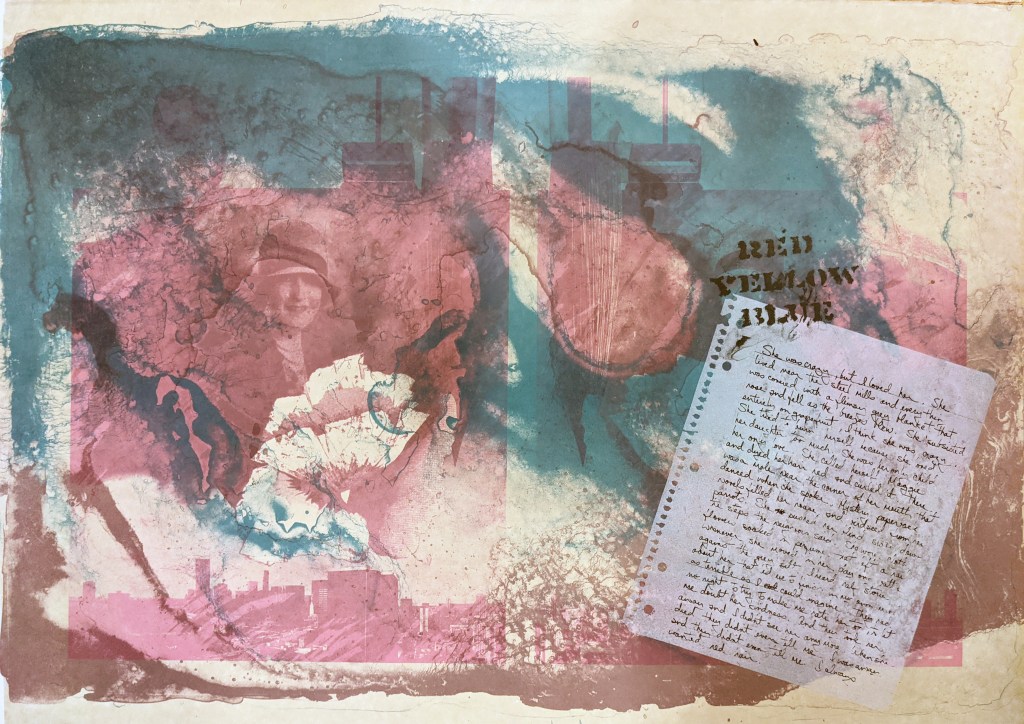
My father’s mother was crazy, but I loved her. She lived near the steel mills, and everything was covered with a flimsy grey blanket of silt that rose and fell when the wind stirred. She subsisted entirely on grapefruit. I think she was crazy. She tried to burn herself because she loved my father too much, my mother said. He was her only child, her only love. She called herself Dolly, dyed her hair red, and curled it. There was a mole near the corner of her mouth that danced when she spoke. Mystery paperbacks filled her house and birdseed from her parakeets. She would hold a seed in her lips and her bird would gently retrieve it. My mother said she pushed her blind mother down the steps. Dolly wore cloth flowers soaked in perfume that left a trail wherever she moved in her daylong battle against the dust. My mother told me half stories about her that led me to finish in my mind as terrible as I could imagine. She had no right to try to make me hate her too, to let me doubt her love. Dolly, let me sleep in the little room in the big brass bed by the window where the breeze spars with the curtains and the clock in the hall counts the seconds. She had a heavy iron elephant painted yellow that, by turning its tail, a single cigarette would drop from its belly. She broke her hip falling down the steps rushing to escape the fire. They took her to a nursing home, and we didn’t go to Indiana to visit her any more. When she died seven years later my mother didn’t tell me. I was away at school, and she didn’t tell me. I always wanted red hair.

Photo: FJ Martinez
Finalist in Tartts First Fiction Award 2023. Printed in “Tartts Nine, Incisive Fiction from Emerging Writers Anthology,” August 2023.
The two kids – excuse me – young adults, who’d peeked into the half-open door of my loft appeared to be barely out of their teens, oozing with energy, confidence, and optimism.
“You’re, Max, right?” the girl asked.
“So, who might you be?” I did my best to sound like a pirate, the Long John Silver of DUMBO, though I had both legs and no immediate plans for a parrot. Word in the building was I had great carpentry skills when I cared to use them which is why, most likely, these two visitors had dropped by.
“I’m Ben. This is Celeste,” said the scrawny guy.
Though in my early forties I knew I looked older and felt older than most of the tenants in the building. Frankly, I was a little beaten up by life, visibly overweight with eyelids hovering halfway up or down like I might be tired, bored, or drunk, but I was just lazy.
“We leased the second-floor loft in the back on the concrete side of the building and moved in a couple of weeks ago.”
I gave them one of those over the eyeglasses stare downs like my dad used to give me when I interrupted him reading his paper. I saw right away they were confused with why I might be annoyed with them. After all, we’d never actually met. I purposely didn’t appear friendly, showing no smile or twitch of my mustache above my black full beard. I was inscrutable.
(Click on number 2 to continue reading the story.)

As published in THE HONG KONG REVIEW, Volume III, No. 3, Fall 2022
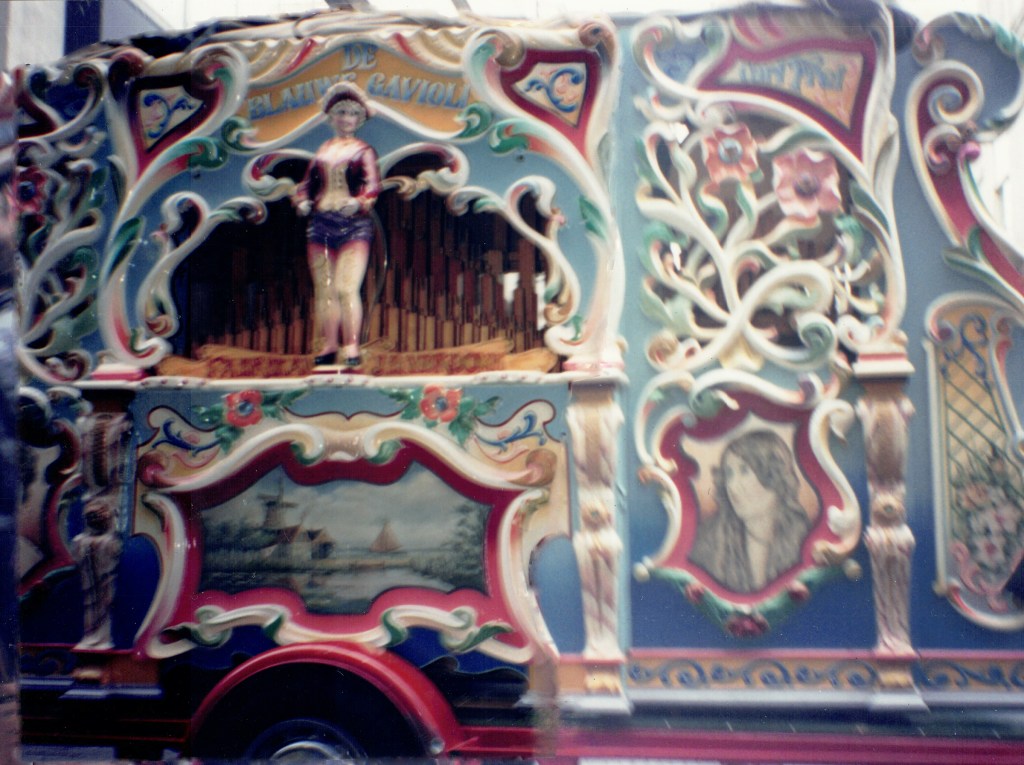
I was struck speechless that afternoon in 1932 when I first saw Mr. Herbert’s Stromboli’s Nights of Wonder Carnival in a trampled corn field in Toledo, Ohio.
Even a dumb twelve-year old like me could see it was all fake, a jerry-rigged assortment of broken-down kiddy rides and game booths with worthless prizes. But at night, when the twinkling fairy lights were lit, the canned music blared, and popcorn and cotton-candy machines spewed enchanting aromas, I was bewitched, and I lived there that summer.
“Who’s Stromboli?” I asked Mr. Herbert, a childhood friend of my father.
“Some guy I met in a bar. Sounds classy, right, Bernard?” he said.

https://www.sledgehammerlit.com/post/takeout-by-suzanne-martinez
Published by Sledgehammer Literary Journal, February 8, 2022. Link is currently not available.
Muffled steps approached as we walked with our pizza and wine down the hill toward the shadowy patch under the highway.
“Check this out, guys,” a husky voice stage-whispered behind us.
Ben and I turned to face three teenagers – basketball shorts, arms and legs like sticks, a gun. The kid holding the gun was fidgety, his knuckles scabbed. His eyes were a pale grey. No one was smiling.
They spread out.
Heart pounding and palms sweating, I embraced our pizza like a shield. It was a rare extravagance. Usually we just bought a couple of slices, but it was our two-year anniversary of living, working, and making art together in our loft in Fort Greene.
The gun looked fragile, like a toy. I prayed it was.
They probably thought we had more money than they did. Why not even things out a little? Three against two. I thought to offer them the five dollars we had left after buying dinner, but up against a gun, it didn’t seem close to enough.
“Empty your pockets,” another one said. His voice cracked and his friend punched his shoulder like a big brother would.
Ben cradled our cheap bottle of wine.
I searched the deserted street for rescue. Usually someone was out walking a dog or rushing home with groceries.
No one.
“You don’t to want to do this,” Ben said as he took one step toward them. I watched him reach behind his back and grab the bowie knife he tucked in his waistband against emergencies. I wanted to scream, but I couldn’t remember how.
Ben had come to New York to become an artist from west Texas where everything bit, scratched or stung. He was always ready for anything. I’d come from Ohio to see if I had any talent, hoping to stay.
It was a Brooklyn stare-down.
The hum of traffic on the overpass was like a white noise machine. The perfect soundtrack for a takedown, until a tractor-trailer’s airhorn blasted over our heads before rumbling on to Queens.
Everyone flinched.
The gun boy’s eyes flickered upward. An almost imperceptible spasm began in his bicep and slowly traveled down his arm to the hand gripping the gun. He squeezed his fingers and the barrel exploded. The crackle ricocheted from the roadway pilings.
Searching Ben’s eyes for pain or a dark stain on his chest to spread, I opened my arms to catch him.
The bullet had passed between us vanishing into the ether, finding neither soft tissue nor hard bone.
As if snatched by an invisible tornado, the boys took flight like moths into the spring night. Their footsteps hushed by our pounding pulses.
We stumbled home clutching each other, conjoined by our reprieve.
Huddled together, we gagged on the pizza. Ben’s hand trembled when he poured us glasses of wine, dripping it everywhere. A small red blotch struck the rug spreading to the edge. We dumped the rest down the sink. It cost us too much to drink it.

https://gonelawn.net/journal/issue43/Martinez.php
Published by Gone Lawn, Issue 43, January 31, 2022.
Click on link to read story.

Published in The Best Short Stories from The Saturday Evening Post Great American Fiction Contest 2022 Anthology Honorable Mention (https://www.amazon.com/Stories-Saturday-Evening-American-Fiction-ebook/dp/B09PGPJ934)
Ben and Celeste had fallen in love in Brooklyn at art school where they’d bonded over their passion for making art, printmaking, and personal reinvention after bad first marriages. They looked like brother and sister, compact and dark haired in their twenties. The previous spring, when Celeste discovered there were no college teaching jobs available despite her brand-new MFA, Ben suggested they start their own fine art printshop.
“We’d own the presses and can make art whenever we want,” Ben said. “Artists and publishers will pay us to print their editions and we won’t have to rent press time. Everything would be under our control.”
“Sounds like a great plan, Ben. You think I’ll have time to make my own prints?”
“We both will. I promise.”
(Click on number 2 to continue reading the story.)