When we were kids, our mother claimed, she was forced to cook dinner for her family of seven every night from age twelve until she married our father, who also expected dinner every night, so she cooked daily with great resentment because she was an artist, destined for extraordinary things.
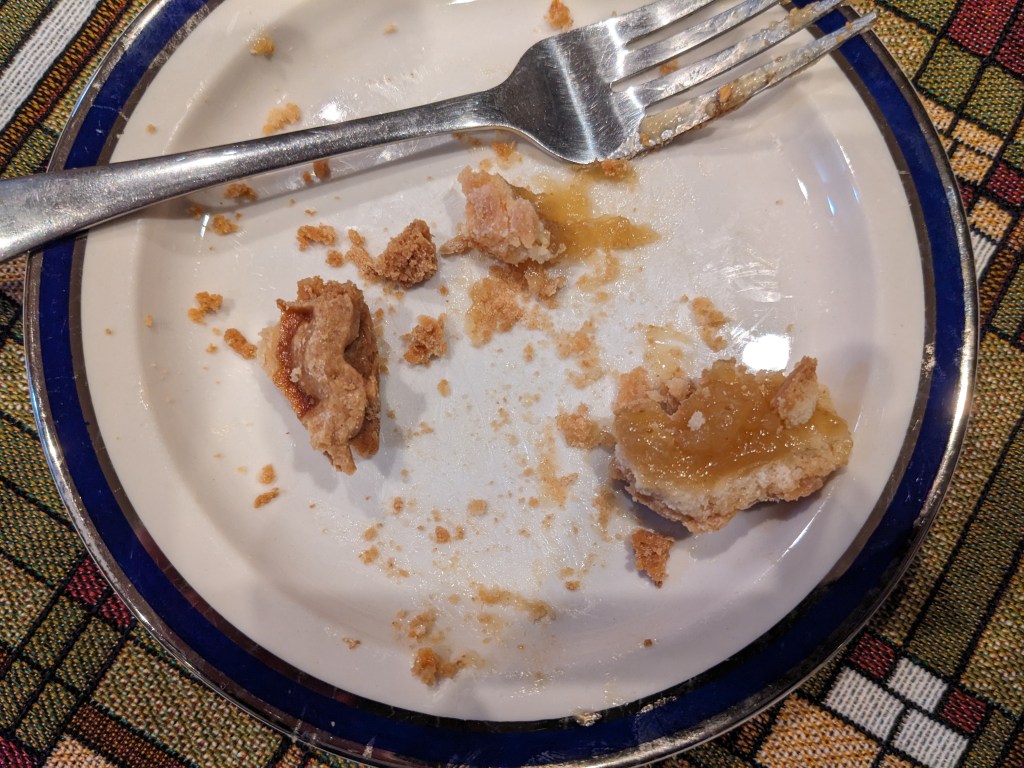
But only for Thanksgiving, she’d make her best thing, her sole kitchen triumph, her unforgettable butterscotch meringue pie – from scratch.
Using proportions magically stored in her head, she’d measure the flour, water, and shortening by eye for the crust and patiently cook the eggs, milk, cornstarch, and brown sugar, constantly stirring, to make the custard.
Once she’d baked the crust to a golden brown, she’d fill it with the thickened butterscotch filling, followed by a stiff layer of severely whipped egg whites, which she’d place under the broiler to brown the meringue tips standing proudly on top.
Years later, we can still close our eyes, awed by its symmetrical perfection displayed on the counter before she cut anyone a piece and imagine inhaling its unique aroma, tasting its velvety sweetness, and biting into the perfect crunch of the crust.
Brimming with domestic contentment, we forgive her the hundreds of awful dinners she’d served us all year long for one piece of her pie because she truly was an artist, and butterscotch pie was her pièce de resistance.
We’d discussed getting a dog for a while. I needed someone who would greet me with warmth and approval. My stepson, Kevin, couldn’t. He’d wake angry, and sleep angry since his mom put him on a plane at the LA Airport in August and called us to meet him in NYC. He’d slept on the couch for weeks until we built him a bedroom in the loft.
When Kevin descended the escalator to Baggage Claim, I recognized him instantly, though I hadn’t seen him in four years. At thirteen, he was five feet tall with big hands and feet, like a puppy foretelling his future height. Kevin was scared. His eyes darted everywhere and were open so wide it must’ve hurt. His jaw was clenched. He walked reluctantly toward us – his dad, Ben, who’d moved East eight years earlier, and me, his step-mom. He glanced around as if toying with bolting, but we quashed his plans with hugs he didn’t return.
Four months later, Ben spotted the scruffy dog loitering in front of our building in DUMBO, Brooklyn. A blizzard was forecast for that New Year’s Eve afternoon. After a few ear scratches, she followed Ben inside like she was coming home. We offered her canned tuna in water, undrained, and she inhaled it in seconds.
The dog was filthy and had no ID tag. I bought her a collar, leash, and food and drove her to the vet. The doctor guessed she was eight months old, lived with a family who deserted her or got lost, and lived on the street for about a week. The vet gave her puppy shots while she looked on as if some other animal was getting stuck. It was snowing hard as I drove to her home. Kevin stayed in his room.
We bathed her. She was 35 lb. and a redhead, assembled from random dog parts – the long nose of a Collie, a Weimaraner’s brown snout, ears from a German Shepherd, and a tail that wagged constantly. Despite posting flyers, no one claimed her, and she became our dog, our Paloma. Timing walkies was tricky. We observed her for signs she needed to go out. Once outside, she’d follow behind, tapping Ben’s or my leg with her nose, keeping an eye on us so we wouldn’t run away.
Published in North American Review, Open Space, December 13, 2024
“So you’re driving upstate again?”
She lunged for their toddler before he tumbled down the steps. She held him on her hip as his tiny limbs scissored in front and back of her body.
“I want to check out some real estate.” He pulled his T-shirt over his head in one fluid motion. “Something bigger that we can afford. There’s nothing around here.”
“The baby’s fifteen-month checkup’s today. They’ll give him shots.”
He ignored the baby’s tiny hands reaching out toward him and stared at the street. At seven in the morning, nothing stirred.
“You’ll be fine. You don’t need me.”
“It’s easier with two people if he’s fussy after the shots.” She stared at the back of his head, willing him to see how much the baby looked like him, how blue his eyes were, how his red hair lit up his face, but also to see her, to look at her like he used to, the way she was now.
The three-room cottage contained their whole world.
The baby pawed her breasts and whimpered. She shifted her weight.
The father didn’t turn. “While I’m gone, maybe you can straighten up the house, do some laundry. This is my last clean T-shirt,” he said pointing to his chest.
“Yeah.”
“Okay, I’m off.” He brushed her cheek with his lips and kissed the baby’s head. “I’ll text you if I’m not coming back tonight.”
He bounced down the steps and jogged to his pickup.
She buried her face in the baby’s silky neck, breathing in his newness. She kissed his head in the same spot her husband had. The baby patted her cheek, blotting her tears.
They’d hardly made love since their son was born. But sometimes once is all it takes. She wanted to tell him her news but dreaded his reaction. Their place was crowded, all the toys, tiny clothes, and baby stuff. When the baby couldn’t sleep, his cries filled every minuscule sliver of space inside the house and drove her husband to get up, whatever the time, and do dishes or clean the bathtub. Anything to distract him from baby cries.
They’d lived contentedly in the tiny space for six years, but she’d wanted a baby so much. She’d needed one. Her body felt incomplete without one. Her pregnancy had been a joyful surprise that he seemed to share, but as the house filled with baby gear, he stubbed his toes and tripped on tiny obstacles. His trips away became more frequent.
Frequently, Joe forgot he couldn’t walk unaided anymore. Remembering infuriated him. In his eighties, with papery skin and alert, piercing eyes, he also didn’t remember how long he’d been at the facility, but he suspected it had been many years. Conversation passed the time.
“How are you today? We’ve met, but I can’t recall….”
“Seth.” He pointed to his clip-on badge.
What a coincidence! His son’s middle name was Seth. Joe wanted it for his first; his wife wanted Robert. She won.
Seth was in a body cast in a reclining wheelchair; his face swaddled in bandages covering his many injuries. It was hard to discern his age, but he sounded to Joe like a man in his early forties. He was intelligent and affable but contained. Though he couldn’t retain his name, Joe remembered liking him from their first meeting, whenever that might have been.
Seth’s eyes closed.
“Not feeling sociable today?” asked Joe. His smile created deep vertical wrinkles on each side of his face. He’d slept well the previous night and felt sharper than usual. Joe’s memory had gone bad along with everything else, leaving his recollections until his forties clear as day, but later years were spotty or gone altogether.
Joe’s chair wheels were locked, so he’d be facing this dour young man until he could get one of the attendants to drift into his vicinity and move him.
Seth spoke. “Hemingway penned an observation for us in our current state, ‘the world breaks everyone, and afterward, many are stronger at the broken places.”
“You lay out a challenge, bud. Goddamn, they’re going to have to wrestle me out of here, kicking and screaming. My sole aim is to raise hell and leave this earth with nothing left on the table. Broken or not. I’ve got a few good years left.”
“My dream is the same as yours, except for minor details like remembering my old life and what it was like,” said Seth.
“You talk like an academic. What do you think your livelihood might be?”
“Don’t know, maybe a literary critic or a teacher. I remember whole passages of prose and poetry but nothing else.”
“Relax, it’ll come back in time. I remember the oddest things on the even days.”
“Funny, Joe. How about you?”
“I was an attorney.”
“You enjoy it?”
“Despised it. I never took the time to enjoy life or my family. I recall a huge fight with my son, who wanted to be a writer. I knew how brutal the world was and wanted him to be practical and study business.”
Joe ached for something intangible he couldn’t name. His thoughts were like gnats, annoying the hell out of him, then gone.
“Why are you here?”
“The guy rolled me here,” said Joe. “Sorry if I’m wrecking your morning.”
“No, I mean – why are you in this rehab center?”
“I’m not exactly sure. My wife’s been dead a while. My kids are gone. I have a couple of bum knees no doctor will touch, bad hips, and plantar fascia on both feet. My conditions have conditions. I expect I’m guilty of living past my expiration date. I’m probably dead, but no one’s bothered to bury me.”
Joe scoured the sterile dayroom for signs of life. The residents appeared like a still-life tableau against the sunlight streaming in the windows. It seemed that Seth was the only one semi-willing to chat.
“What happened to you if you don’t mind my asking? Seth, right?” Joe asked.
“Right. The cops guess I was knocked out, robbed, and rolled off the subway platform onto broken glass. I can’t remember anything. If I’d lost my ID, they wouldn’t even know my name. Apparently, I live in Chicago.”
“What were you doing in New York?’
“Not a clue.”
“Some people aren’t human! When did it happen?”
“Fifteen days ago, they said. A dishwasher on his way to work spotted me unconscious on the tracks at three in the morning. Amazingly, I wasn’t crushed by a train.”
“A godsend. What about family?”
“They’re working on it. All I had on me was my driver’s license, a two-dollar bill, and a couple of red and white pinwheel mints.” He shook his head. “Sounds like the clues for a cheesy mystery, doesn’t it?”
“I remember those candies, my boy’s favorite. Haven’t seen them in years.”
“He lives nearby?”
“Who knows? I misplaced him long ago. After we disagreed about his future, he left. I said things I shouldn’t have. I’ve regretted that conversation for twenty years. My sole ambition is to find him and say how wrong I was.”
“Sorry, Joe.”
“Two-dollar bill? I haven’t seen one of those in a long time. I used to put one in the Valentines I gave my kids every year. I stopped after they grew up.”
Joe could recall the faces of his daughters, though they’d died years ago, his son’s not so much.
“They found my two-dollar bill in a secret compartment in my belt buckle. Pretty ingenious. It’s all the money I have in the world.”
“I think they’re supposed to be lucky. No wallet or phone?”
“Probably stolen. My license was in my shirt pocket. I guess the mugger didn’t have a sweet tooth.”
The clock’s minute hand shuddered and advanced. Another hour until lunch.
Joe sensed something rattling around in his head. He pictured his brain as a chunk of Swiss cheese with top-secret hidden passageways. Suddenly, one of his leg spasms struck, making him forget everything but the shooting pain.
Until the lunch gong rang, both men dozed intermittently.
An attendant unlocked Joe’s wheelchair, and he headed for the dining room. A second attendant pushed Seth near him.
On an impulse, Joe asked, “What’s your last name?”
“My license says Williams. It’s really common.”
Something shattered in Joe’s chest like a baseball hitting a windowpane. There was something about that name. He wished he could remember what.
Click on link to read story in archives (03-02-24) Or read story below.
1
My sister found our parakeet, Hercules IV, dead on his back in his cage that hung near the telephone. Hercules, one in a series of less-than-robust birds purchased from the pet store at the strip mall, loved chattering whenever anyone was on a call. He’d learned to imitate the phone ringing, which caused frustration when one of us raced from the bathroom to answer it, or rather him.
My sister was eight years old and had not yet chosen a future occupation. Two years older, I was undecided myself. Our grandfather had died a few months earlier, and we’d attended the funeral. Possibly inspired by that experience, she announced her intention to bury Hercules. Our mother had no objection, having previously deposited Hercules I, II, & III in our kitchen garbage can.
My sister found a shoebox, wrapped Hercules in a sock that had lost its mate, picked wildflowers, and glued two popsicle sticks together to form a cross after sacrificially eating a frozen treat that stained her tongue blue. A few kids from the neighborhood attended the ceremony, which included a speech by my sister about Hercules’ brief though wonderful life, a moment of silence, and a rendition of “Twinkle, Twinkle, Little Star,” with almost everyone chiming in. There was a scuffle over who would fill in the hole after she placed the box in the bottom which was settled after someone suggested everyone throw in a handful of dirt simultaneously.
(Click on number 2 to continue reading the story.)
Click on Suzanne’s name to read the story or read below..
Nearly Father
Sam lunged for the door at the first knock so that Caroline wouldn’t wake. She hadn’t been sleeping well lately, getting up frequently at night. This pregnancy seemed different than the others.
“Are we really going out fishing?” asked Lincoln, Sam’s neighbor. At ten, the boy was wiry and bursting with energy.
“Nothing will stop us today.”
Pressing his finger to his lips, Sam handed Lincoln the fishing gear and snacks. He carried the bucket of bait. When he was Lincoln’s age, he’d never gone fishing with either dad. His birth father got seasick watching Jaws, and his stepdad, the Colonel, had no time for a boy. Sam spent time skateboarding with his friends, avoiding the cops. He’d often been close but never in real trouble. Sam said he didn’t care if his dad spent time with him, but that was a lie.
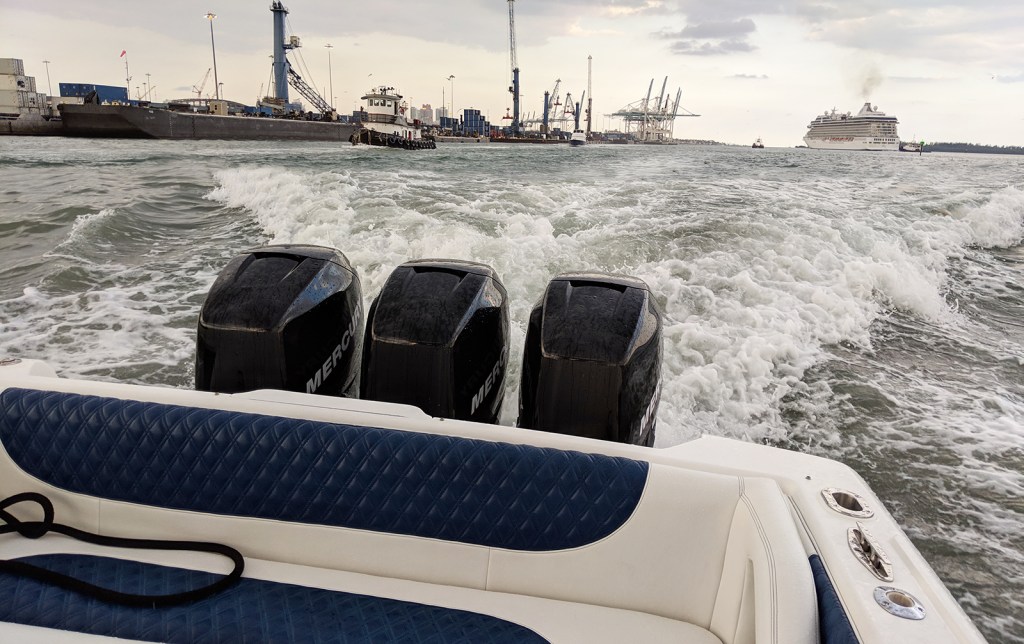
Lincoln and Sam had become fishing pals the year before after Lincoln kept asking Sam if he could go with him. Soon, slathered with sunscreen, they headed out of Miami Beach Marina in Sam’s single-engine motorboat he’d brought back to life over the last nine months, buying each replacement part one by one when he could afford it. With his own boat, he had options. He could take off for the Keys or go to the Bahamas on a whim. Today, they drove a mile offshore toward the cruise ship lanes, where he knew the big fish were.
After baiting their hooks, they laid out lines.
“I saw a gecko in the window this morning, Sam. They’re lucky.” Like most fishermen, Lincoln and Sam were superstitious.
“I hope you’re right. I heard a guy in Boca landed a marlin yesterday.”
Two hours later, they were silent – fishing, waiting, enjoying the ocean breeze and the gentle roll of the boat. When Sam was out on the water, his anger at his boss’s demands and worry over Caroline’s pregnancy would mellow for a few hours.
Sam turned away to pee off the side, and Lincoln’s line got a bite. The fish pulled out so fast that Sam barely caught Lincoln before his feet left the deck.
“It feels like something big,” said Lincoln, squirming like a puppy.
“As big as you. Brace yourself against me. It’ll be hard to explain to your mom if I lose you.” Sam heard himself and realized that was what a father would say. It was something he would say to his child. I’ll keep you safe.
A couple of years ago, the prospect of becoming a father was something he had dreaded, but Sam felt almost ready.
“What do you think it is?” Lincoln’s muscles were taut, his chin set.
“Hard to say until it shows itself. Hold your arm steady; keep up the pressure, no quick moves.”
Sam felt his phone vibrate in his pocket. “Hi, Caroline. How’re you doing?” Sam kept his arm around Lincoln’s waist and sat on the bench. “You sure? So soon? We’ll leave now. Everything will be fine. I’ll be there.”
Sam would be a new dad when many men his age thought of grandkids. He’d aimlessly drifted through a series of superficial relationships in his twenties, thirties, and most of his forties. His boyhood had few good memories of family after his parents’ divorce; his mom remarried and had more kids. He always felt out of place wherever he was, like an appendix, a vestigial organ. But Caroline had burrowed into his heart and changed him.
“I can’t believe it.” Lincoln pointed at the long blade projecting from the front of the fish. “It’s a marlin.”
Sam looked at the joy on the boy’s face. “Caroline is having a baby,” he said, not loud enough for Lincoln to hear. Lincoln’s parents were always too busy to take him fishing. The boy had waited over a month for this day. “Let’s get that fish in.”
Sam helped Lincoln pull back on his rod and spun the reel to shorten the line. He held Lincoln’s shoulders to keep him steady while he pictured Caroline’s pre-birth checklist. Her ‘go’ bag was packed. She had to find someone to walk the dog, but the car was parked in the alley with a full tank, and she knew the way to the hospital in her sleep. Sam’s conscience jammed in his throat, but he pushed it down. He’d always been good at hedging things. Caroline wanted to be a mother more than anything. She’d be fine.
“I can see its dorsal fin. It’s getting tired.” Lincoln was glowing, jumping up and down.
“Keep reeling it in. Don’t rush.” They worked as a team, pulling the fish closer.
Glancing to the north, Sam caught the flash of a speedboat going too fast. He turned Lincoln’s head and pointed. “Let the line go slack. He’ll slice it when it crosses us.”
Lincoln let out as much line as he could, as fast as possible, but it wasn’t enough. The speedboat cut the line, and Lincoln ricocheted onto the deck. The marlin disappeared into the sea, a hook in its mouth. Sam wiped the boy’s tears.
“Sorry, Linc. It was a beautiful fish. You would’ve had him if it weren’t for that idiot.”
“I want to go home.” Lincoln pulled on Sam’s hand.
“I need to find Caroline.” They should’ve left earlier.
Sam stowed the gear and held his breath until the finicky engine caught. He prayed to the sea gods he wasn’t too late as he tapped her number. “Caroline, where are you?” She was nearly forty. After two miscarriages, this might be their last chance.
The connection was bad. “I’m on …. Mainland …… a mile …… hospital……. Contractions……. Minutes…. Where are YOU?”
“On our way. I promise I’ll be there. Wait for me.”
Bernadette lives in a flat house in West Texas. She often forgets being old until she walks past a mirror or a window and sees the skinny, slightly hunched, somewhat wrinkled body she knows is now hers. She ignores it by keeping busy, tending to the flowers and trees in her yard which seems to get a little bigger each year.
“Hello, kitties,” she coos as she comes outside to sit under her patio awning, shielded from the relentless sun. She listens to them mew as they slink around her, making overlapping curvy trails that crisscross her legs and each other as if they are weaving a tale.
“Here’s your dinner, my sweets,” she says, wishing she was serving watermelon to grandchildren and not stray cats looking for Meow Mix. The cats stop crying and eat without fighting when she puts all the aluminum pie plates down.
I’m still here at ninety-one, she tells herself. My legs work and brain work and I have a roof over my head, owned free and clear. I have my telenovelas and Lester Holt every evening. I have leftover barbecue chicken and a fresh peach from my neighbor. I am fine.
The warm breeze dries the sweat on her face and arms, cooling her. She leans back in the lawn chair and closes her eyes for a few minutes to rest. Bernadette sees someone walking in her yard, coming toward her from the road so far away. It’s a woman who is very small at first but keeps getting bigger as she comes closer. She appears gray and nearly transparent but gradually becomes bright and solid, and the old lady gasps, seeing the woman wearing a multi-colored dress.
Bernadette remembers that dress from long ago, recalls buying the fabric and carefully cutting it out, using a special pattern begged from her older sister. Bernadette pinned the parts together and sewed the seams one by one, fit each of the sleeves into the arm holes, which was always tricky and took patience, something Bernadette had little of then. It took hours to set in the zipper and make it smooth and even. Finally, she ironed each seam flat like her mother had taught by her.
This dress was for a dance. A nice young man had invited her, and her mother had said okay. It was her first dance and her first date. The dress had to be perfect. She could still feel the fabric resting on her arms, soft and clingy. The skirt cascaded from her tiny waist, hugged her hips, and fluttered against her knees.
Bernadette was sixteen. She had long black hair and eyes so dark people swore she had no pupils. Everything was brilliant and new and special that night. She danced for hours, and her feet didn’t feel the floor. He held her gently like she would break if he let her go.
We were pretty wasted when Gus announced his birthday wish was for us, Arnold and I, to go deep-sea fishing with him. Gus loved the water, loved to fish, and wanted to show off his new boat. I’m not a big water guy. I got seasick watching Jaws, and I was pretty sure I wouldn’t enjoy a day on the water but refusing Gus and staying behind would’ve been worse. I’d been mostly vegetarian since leaving home from conviction, as well as economics. Since I’d been in New York, I’d forgotten the source of meat or fish was a living creature. Other than a fly or a mosquito, I’d never killed anything. I hoped today wouldn’t be the first.
We left the dock at 5:00 am. Three men in a boat. None had slept more than a few hours after drinking and talking about art and life well into the night, while a late summer storm raged outside that ended before dawn. A light mist, like a Turner seascape, burned off as we chugged east toward the sunrise through the inlet at East Marion, Long Island in Gus’s new twenty-five-foot Grady-White for its inaugural voyage on the Atlantic Ocean.
Nauseous immediately, I leaned over the boat’s side to empty my stomach into the inlet. With it went my Dramamine and any hope of enduring the journey unscathed. I should’ve taken the pill when Gus handed it to me the night before, but I’d fallen asleep with it in my tee-shirt pocket.
Gus was turning forty. He’d grown up poor in Yonkers proudly maintaining his horrible neighborhood accent. After high school, he joined the Navy before going to college on the G.I. Bill and earning a Ph.D. in Arts Education. He taught Painting and Printmaking at two local colleges. He was loud and tall with countless tattoos, big hands, and feet, and he seemed to take up most of the space in the boat.
“What’s the problem, Benny? We aren’t even out of the Sound. The water’s as smooth as a baby’s ass. How the fuck can you be sick already?” Gus rubbed my back. “You’ll get your sea legs soon.”
Gus and his wife, Jenny were both artists who lived in a Canal Street loft in Manhattan during the week. They’d invited Arnold and me with our significant others to their sprawling house with its own dock on the North Shore for Gus’s Labor Day weekend birthday celebration. The house was a wedding present from Jenny’s wealthy parents. She’d bought Gus a new boat for his milestone birthday after his smaller one sunk in a Nor’easter the previous spring.
“It’s going to be a great day, Benny. They say a bad day fishing’s better than a good day working. Look. Arnold isn’t sick.” Gus slapped his back causing Arnold to grab the gunwale.
Arnold, Gus’s former student, was also an artist. They’d become friends years ago, but I was a recent addition to his circle. Earlier in the year, my girlfriend, Celeste, and I met Gus through the Madison Avenue art gallery who represented him. The gallery owner hired us to collaborate with Gus to produce a limited-edition print to accompany his one-man show of Neon light paintings slated for the following year.
We both liked Gus from our first meeting and spent many hours together working on his print at our atelier. After a long day working in our loft, he’d take us out for Indian or Chinese food to talk about art until they closed the place for the night. We were eager listeners. He introduced us to his artist friends and gallery owners at openings, telling everyone they should hire us to make their prints.
Published in The Blue Mountain Review, September 2023
My thirty-year-old son sits across from me in the neighborhood diner. His hair is thinning at the front, but too long. He needs a haircut. At six months, he had a head of hair so thick it looked like an old man’s toupee.
I stumble into the emergency room, directed to a body strapped to a gurney, the face covered in blood, one leg splayed out at an unnatural angle. Who is this?
He smiles at a little joke he’s told me, and I see his straight even teeth, so different from his mouth as a two-year-old with milk teeth like a tiny comb.
A bloody hand reaches out to me with the tapered fingers and long thumb of a pianist. I shrink away from its coldness, but I know this hand.
He butters his toast and tells me about his week at work. His eyelashes are as long and dark as they were at birth, and they brush his cheeks when he smiles.
A neck brace keeps his mouth from moving. But I hear a faint voice say, I’m okay mom. I’m okay, don’t cry. It’s as if it’s come from a ghost.
I worry he works too much at his new job, striving to climb the rungs to the next level. As a toddler, he never sat down to eat. He always had an agenda, a project, a mission.
I need to cradle him. I need to count his fingers and toes and run my finger over his tiny ears, his nose, his mouth. But they take my baby away to the O.R.
I take his grownup hand in mine, squeeze it gently, and let go before he does. As a boy, he never wanted to hold my hand to cross the street, but I held it anyway.
Published in The Blue Mountain Review, September 2023
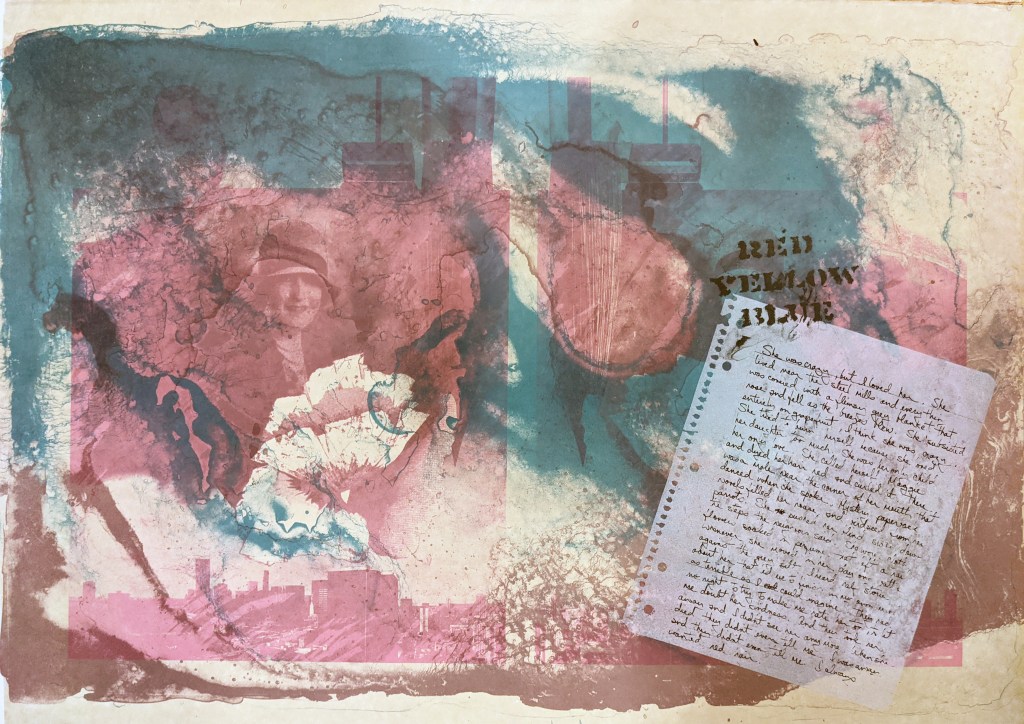
My father’s mother was crazy, but I loved her. She lived near the steel mills, and everything was covered with a flimsy grey blanket of silt that rose and fell when the wind stirred. She subsisted entirely on grapefruit. I think she was crazy. She tried to burn herself because she loved my father too much, my mother said. He was her only child, her only love. She called herself Dolly, dyed her hair red, and curled it. There was a mole near the corner of her mouth that danced when she spoke. Mystery paperbacks filled her house and birdseed from her parakeets. She would hold a seed in her lips and her bird would gently retrieve it. My mother said she pushed her blind mother down the steps. Dolly wore cloth flowers soaked in perfume that left a trail wherever she moved in her daylong battle against the dust. My mother told me half stories about her that led me to finish in my mind as terrible as I could imagine. She had no right to try to make me hate her too, to let me doubt her love. Dolly, let me sleep in the little room in the big brass bed by the window where the breeze spars with the curtains and the clock in the hall counts the seconds. She had a heavy iron elephant painted yellow that, by turning its tail, a single cigarette would drop from its belly. She broke her hip falling down the steps rushing to escape the fire. They took her to a nursing home, and we didn’t go to Indiana to visit her any more. When she died seven years later my mother didn’t tell me. I was away at school, and she didn’t tell me. I always wanted red hair.